
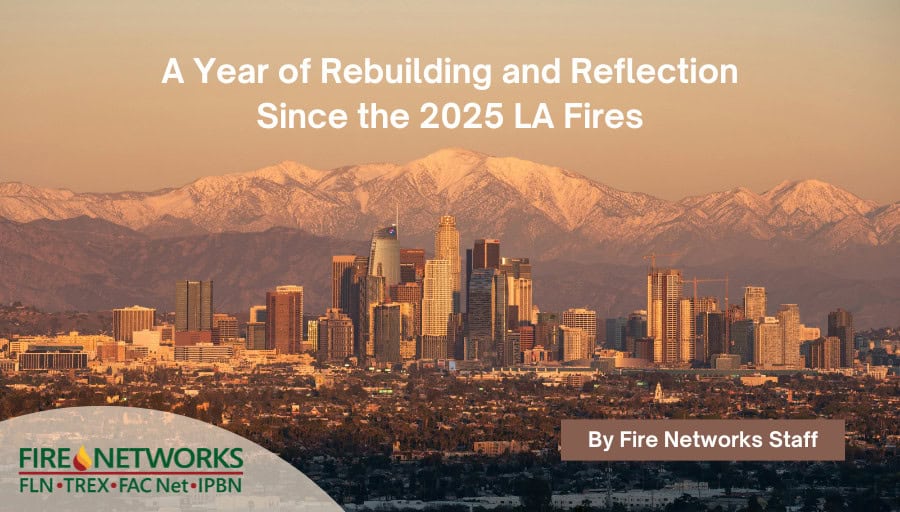
In the winter of 2025, a year ago this week, the Los Angeles area experienced a cascade of fires — among them the Palisades Fire and the Eaton Fire — that led to the evacuation of thousands of people from their homes and tested the resilience of emergency systems, community organizations, and local governments alike. Since these fires, we’ve had months of rebuilding, reflection, and collaborative learning about what it means to live with wildfire in an urban landscape.
The Fire Networks is dedicated to supporting fire practitioners and offering resources and learning opportunities, and we extend care to all that have been impacted by the 2025 LA Fires.
Fire in a Highly Urban Landscape
The 2025 LA Fires moved through densely populated neighborhoods with a lot of infrastructure. Roads became evacuation chokepoints. Power shutoffs and smoke exposure affected people far beyond the burn perimeter. In some areas, homes burned structure-to-structure, driven by embers and wind.
Post-fire analysis shows stark contrasts: some homes survived while neighboring structures were lost. Building materials, maintenance, defensible space, and the presence (or absence) of nearby combustible features all played a role. These outcomes have renewed conversations about building codes, retrofits, and what “fire adapted” means in an urban context.
The Long Tail of Recovery
Now a year post-fires, recovery challenges are proving persistent. Many residents are encountering delays or denials in insurance coverage. Small businesses are struggling to reopen amid declining foot traffic and damaged infrastructure. People are still experiencing long-term respiratory issues and stress-related conditions from the fire’s smoke and presence.
These experiences reinforce that wildfire recovery is uneven. The ability to rebound depends on income, housing tenure, language access, and social networks — factors that shape who can stay, who must leave, and who is heard in recovery decisions.
A Few Resources for Deeper Reflection
There is an incredible wealth of resources and information about the LA Fires and their lasting impact. The following pieces offer a few perspectives into understanding the fires and their implications:
- Governor Gavin Newsom – One year after Los Angeles firestorms, California continues all-of-government community recovery efforts
A state update detailing how California is working with local partners to accelerate recovery from the LA fires. - The Lookout – One Year After LA Fires (YouTube Video)
Zeke Lunder of the Lookout is joined by Tim Chavez and Denny O’Neil for a retrospective on the LA Fires and a recap of the docu-series they made, “Danger in Plain Sight.” - CalMatters – Many L.A. fire survivors face insurance delays and can’t return home a year later
An exploration of how the fires accelerated ongoing insurance challenges, shaping recovery options and long-term community stability.
Looking Ahead
The 2025 LA Fires underscored that wildfire adaptation is not only about fuels, response, or suppression. It’s about how communities come together to prepare, how systems support recovery, and how decisions made long before a fire shape outcomes long after.
As practitioners, policymakers, and neighbors, we can invest in prevention that reflects the realities of the landscapes we live on, consider the whole community’s needs in recovery planning, and support place-based approaches to living with fire.
****
Thanks for shouting out our recent Lookout interview. Our five-part LA Fires e-bike tour docu-series (featuring the same trio) is available, here: https://the-lookout.org/danger-in-plain-sight/
PBS Weathered: One Year Later was also really good
https://www.pbs.org/video/weathered-after-the-la-firestorm-elfmgu/