
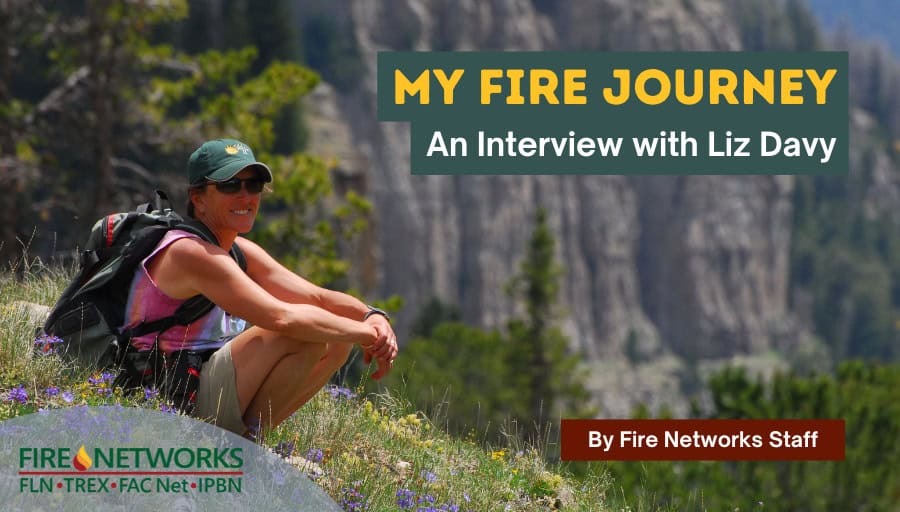
Editor’s note: This interview with Liz Davy is the third in our “My Fire Journey” interview series, in which we feature conversations with fire practitioners from a variety of backgrounds. These conversations are meant to offer a window into how practitioners approach their work, draw inspiration, and keep going in the face of challenges and setbacks. Interviews have been edited for length and clarity, and represent the views and opinions of the interviewees. Read our first in the series, an interview with cultural fire practitioner Chanel Keller, here.
Liz Davy is the Project Coordinator for the Greater Yellowstone Fire Action Committee (GYFAN). GYFAN has been a Fire Learning Network (FLN) region and part of FAC Net since it was formed in 2022. Liz has been an FLN Lead and FAC Net member since 2016 through her involvement with the Island Park Sustainable Fire Community. All photos provided by the author and credit to the US Forest Service.
Fire Networks Staff: How did you find out this field exists? How did you get into it?
Liz Davy:
In 1982, while working on a stand exam crew in New Mexico, I went on my first fire crew training and first wildfire. The adrenaline rush, overtime, and the opportunity to see fire on the landscape hooked me. We ate Sea Rations (yuk), earned good money, and had a great time. I thought fire could be my career, but did not know anything more about it. There were not college courses in fire management, nor was it promoted as a job. So I graduated with a degree in Forest Management and started my seasonal career with the Forest Service on a timber crew. Fire suppression was sprinkled throughout those seasonal jobs as an expectation that we would all go out on fires and as a great way to supplement our wages.
When I was a seasonal marking crew lead in Island Park, ID, we experienced the 1988 Yellowstone Fires. Once again, I was involved in fire suppression and support roles, and I was exposed to fire management teams. We spent three weeks on assignment with a team working 18 hours a day. In those days, women were not the norm in the fire world, and it was not the most pleasant experience to be the only female on a 20 person crew. It was not until I began my silviculture training that I realized there was more to fire than earning money and being dirty all the time. I also realized my personality did not fit that of a full time firefighter; I did not do well with the attitude of “hurry up and wait” when working on a 20 person crew or an engine. The fires then were not the mega fires we see today – and, having less experience, I was the one to stay home and missed out of larger more exciting fires.

What skills have been most beneficial for you in your career? And where or what do you turn to for continuous learning and skill development?
I learned more about fire ecology and how fire could or should be used to promote ecological restoration across the high alpine landscapes of the Greater Yellowstone Area. I observed Mother Nature, her interactions with fire, and the benefits fire brings to the landscape as a powerful restoration tool. I gratefully participated in and learned much about collaboration and working with all resource specialists and eventually became passionate about working with the public explaining how ecosystems function.
I was fortunate to become one of the first Zone Fuels Specialists hired after the 2000 fires on the Salmon Challis National Forest; not for my fuels knowledge or fire skills, but for my ability to lead Environmental Analysis processes. I collaborated with the community and resource specialists to put vegetation manipulation projects in areas to reduce fuels and not produce timber – a whole new experience. I learned from some of the best and had great support from District Rangers and Regional office personnel. I am very proud of working with the public in all aspects of fire mitigation and bringing people together to make the work happen on the ground.

Who is someone who has influence or supported your career trajectory? Tell us about how that person impacted you.
District Ranger Patty Bates supported my budding silviculturist career and then hired me as a Zone Fuels Specialist. She believed in me, my leadership skills and provided me with every opportunity to enhance those skills. Rod Dykehouse, Forest Fire Management Officer, brought me to the Bridger-Teton National Forest as the Forest Silviculturist and provided with enough leeway to develop an integrated timber and fuels program including prescribed fire as a vegetation manipulation tool. Brent Larsen saw ranger potential in me, and hired me as the District Ranger in Ashton/Island Park where I “rangered” for 12 years and started a collaborative wildfire mitigation group to support private landowners in their fire mitigation efforts. This has been my passion since 2012, and I continue it today while working for Island Park Sustainable Fire Community and Greater Yellowstone Fire Action Network.

Thanks for sharing your story, Liz!
****
I’m so grateful for the leadership and follow-through that Liz brings to the network and her FAC work.
Liz is a rockstar combo of passion, intelligence, and care, exemplifying exactly what our lands and communities need at this moment in history. Echoing Becca’s gratitude for Liz’s contributions to humanity!
Good Article, and the C in C rations stands for Combat Rations….not the most flavorful or edible options….hence the ‘yuk’, I’m sure!